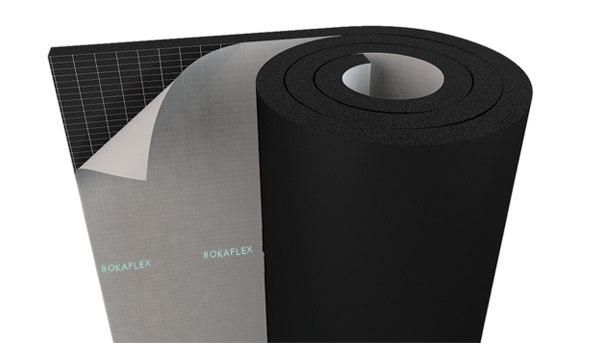

13 * 1000 KY Rubber Elastomeric Roll (Self-Adhesive) / 1 Roll = 14 m² (13 * 1200 KY / 1 Roll = 16.8 m²)
Made to order- Same-day dispatch from stock
- Delivery in Tashkent and Uzbekistan
- Cash and bank transfer
- 12-month warranty
Specifications
- Manufacturer
- World Shakers
Need a quote or advice?
We will make the product in the size you need. Leave a request — we reply within one working day.
Description
Table of Roll Thickness and Volume
| Thickness (mm) | Roll Width 1 m (m³/roll) | Roll Width 1.2 m (m³/roll) |
|---|---|---|
| 6 | 30 | 36 |
| 9 | 20 | 24 |
| 13 | 14 | 16.8 |
| 19 | 10 | 12 |
| 25 | 8 | 9.6 |
| 32 | 6 | 7.2 |
| 50 | 4 | 4.8 |
Table of Material Thermal Conductivity
| Material | Thermal Conductivity, λ [W/(m·K)] |
|---|---|
| Glass wool | 0.033 – 0.042 |
| Mineral wool | 0.032 – 0.056 |
| Foamed polyethylene | 0.032 – 0.038 |
| Foamed synthetic rubber (rokaflex) | 0.033 – 0.040 |
| Polyurethane foam | 0.030 – 0.043 |
| Polystyrene foam | 0.030 – 0.042 |
Table of Material Density
| Material | Density (ρ [kg/m³]) |
|---|---|
| Glass wool | 30 – 100 |
| Mineral wool | 35 – 100 |
| Foamed polyethylene | 25 – 45 |
| Foamed synthetic rubber (rokaflex) | 41 – 60 |
| Polyurethane foam | 60 – 100 |
| Polystyrene foam | 15 – 35 |
Table of Material μ-Factor
| Material | μ |
|---|---|
| Glass wool | 2 |
| Mineral wool | 2 |
| Foamed polyethylene | 2700 – 3500 |
| Foamed synthetic rubber (rokaflex) | 2000 – 8000 |
| Polyurethane foam | 16 |
| Polystyrene foam | 16 |
Table of Material Flammability
| Material | Flammability |
|---|---|
| Glass wool | NG (Non-combustible) |
| Mineral wool | NG (Non-combustible) |
| Foamed polyethylene | M (Melting), G2 (Moderately combustible) |
| Foamed synthetic rubber (rokaflex) | M (Melting) |
| Polyurethane foam | G2 (Moderately combustible) |
| Polystyrene foam | M (Melting) |
Abbreviations:
-
NG: Non-combustible material (does not support combustion).
-
M: Melting material (deforms under heat but does not burn with open flame).
-
G2: Moderately combustible (ignites under prolonged flame exposure, emits smoke, self-extinguishes when flame source is removed).
HIGH THERMAL INSULATION PROPERTIES
Technical insulation made of foamed rubber has excellent thermal insulation properties, reducing heat loss and improving energy efficiency. This is particularly important for thermal systems such as pipelines, air conditioners, and refrigeration units.
LONG SERVICE LIFE
Foamed rubber is highly resistant to physical and chemical impacts. It does not corrode, rot, or degrade under exposure to moisture, oils, acids, or other aggressive environments, making it a durable and reliable insulation material.
EASY AND FAST INSTALLATION
Foamed rubber insulation is flexible and elastic, simplifying installation on various surfaces and shapes. It also has soundproofing properties, reducing noise vibrations.
ENVIRONMENTAL FRIENDLINESS
Foamed rubber is a low-toxicity material free of hazardous chemicals, ensuring safety for human health and the environment.
THERMAL CONDUCTIVITY COEFFICIENT
The thermal conductivity coefficient (λ) measures a material’s ability to retain thermal energy. The unit W/(m·K) (Watt per meter Kelvin) quantifies the amount of heat passing through 1 m² of area with a 1 m thickness under a 1 K (1°C) temperature difference.
-
Lower λ values indicate better thermal insulation.
-
Insulation efficiency primarily depends on microscopic air pockets (pores) in the material.
-
Thermal conductivity varies with temperature, so comparisons between materials must be made at identical temperatures.
DENSITY
Density (ρ) is the ratio of mass (m) to volume (V), measured in kg/m³.
-
Typically, density increases as temperature decreases, but exceptions exist (e.g., water, bronze, cast iron).
-
Foamed rubber insulation density: 41–60 kg/m³.
-
Foamed polyethylene density: 27–41 kg/m³.
WATER VAPOR DIFFUSION RESISTANCE FACTOR (μ)
The μ-factor is a dimensionless quantity representing the ratio of dry air’s vapor permeability to that of the material under identical conditions.
-
Higher μ indicates greater resistance to moisture penetration and stable thermal conductivity over time.
-
Critical for cold insulation systems.
-
A material with μ ≥ 3500 is recommended for systems with negative temperature differentials.
-
For harsh conditions, μ ≥ 7000 is required.
SOUND ABSORPTION
Sound absorption converts acoustic energy into heat, reducing noise levels. This is essential in ventilation and air conditioning systems to minimize noise from fans, exhausts, and circulation equipment.
FIRE SAFETY (COMBUSTIBILITY CLASS)
-
NG: Non-combustible (does not burn in air).
-
G1, G2: Low-combustibility (ignites under flame but extinguishes when the flame source is removed).
-
G3, G4: Combustible (capable of self-ignition or sustained burning after flame exposure).